
Condensing vs. Non-Condensing Tankless Water Heaters
The main difference between a condensing vs non-condensing tankless water heater is how it uses heat from the gas burner. A condensing model captures additional heat from the exhaust before it leaves the appliance. A non-condensing model sends more of that heat outside. That difference affects efficiency, vent materials, drainage and the total installed price.
Both can provide continuous hot water when properly sized. Choosing the right tankless hot water heater means comparing the complete installation, the hot water you use together and the cost of ownership—not just the price of the unit.
Quick answer: Condensing usually makes sense when higher efficiency and long-term fuel savings justify the installation cost. Non-condensing can make sense for a straightforward replacement with compatible venting or a location where condensate drainage is difficult.
Comparison chart · Efficiency and cost · Venting and drainage · Florida considerations · Which should you choose?
Condensing vs. Non-Condensing Tankless Water Heater Comparison
| Feature | Condensing | Non-condensing |
|---|---|---|
| Heat recovery | Recovers extra heat from combustion exhaust | Exhaust leaves at a higher temperature |
| Efficiency example | Rinnai RX199iN: 0.98 UEF | Rinnai RE199iN: 0.82 UEF |
| Indoor exhaust venting | Approved PVC, CPVC, polypropylene or other listed systems, depending on model and local requirements | Typically an approved metal exhaust system rated for hotter gases |
| Condensate | Needs a drain; neutralization may also be required | Some vent configurations still require a condensate collector and drain |
| Upfront cost | Unit usually costs more; approved plastic venting may offset some installation expense | Unit usually costs less; specialized venting can add cost |
| Maintenance | Inspection, scale control and condensate-system service | Inspection and scale control; vent drainage checked where applicable |
These categories describe gas-fired equipment, including natural gas and propane models. An electric tankless hot water heater does not burn fuel or produce combustion exhaust, so this comparison does not apply to it.
How Does a Condensing Tankless Water Heater Work?
Burning gas produces hot exhaust that contains water vapor. A condensing unit extracts enough additional heat to turn some of that vapor into liquid. The recovered energy helps heat the incoming water instead of escaping through the vent.
Many models accomplish this with a secondary heat exchanger. The resulting liquid, called condensate, is acidic and needs an appropriate disposal arrangement. Navien explains this two-stage heat-recovery process in its comparison guide.
How a non-condensing hot water heater differs
A non-condensing unit typically uses a single heat exchanger and exhausts the combustion gases at a higher temperature. It still heats water on demand; it simply does not recover as much energy from the exhaust. A lower purchase price can make this design attractive when the installation suits it.
Efficiency and Operating Cost: What Do the Numbers Mean?
Uniform Energy Factor, or UEF, is a standardized efficiency rating. Compare a water heater with another in the same usage category, or “bin.” As A. O. Smith explains, a higher UEF is more efficient within that category; it is not a guarantee of your household’s bill.
For current product examples, Rinnai lists the condensing RX199iN at 0.98 UEF and the non-condensing RE199iN at 0.82 UEF. Those are ratings for those specific models, not every condensing or non-condensing hot water heater.
A simplified comparison: for the same useful hot-water output under comparable rating conditions, 1 − (0.82 ÷ 0.98) is about 16%. That illustrates the potential reduction in rated energy input. It does not mean a 16% reduction in your entire gas bill, which may include space heating, cooking and fixed charges.
For a useful quote comparison, ask for the total installed price and an annual operating-cost estimate using your fuel rate and usage. Include vent replacement, gas-supply work, drainage, electrical work and permits. A higher-efficiency hot water heater may offer better value over time, but a small household with low usage may recover an installation premium more slowly.
Venting and Condensate Drainage Can Decide the Installation
Cooler exhaust allows many condensing models to use specified plastic vent systems. Rinnai lists PVC, CPVC and polypropylene options for compatible equipment. That does not mean any plastic pipe is acceptable. Material, diameter, length, fittings, slope and termination must match the exact appliance instructions and applicable requirements.
A non-condensing water heater generally needs venting designed for hotter exhaust. Existing vent pipe is not automatically reusable just because the replacement uses the same fuel. Your installer should confirm compatibility and condition before including reuse in the quote.
A condensing hot water heater also needs a route for its condensate. Depending on the installation, that may involve a gravity drain, a suitable pump and a neutralizer that reduces acidity. Rinnai’s condensing installation guidance explains these drainage considerations. The current manual for the selected model controls the actual installation.
One commonly missed detail: non-condensing does not mean condensation can never occur. Rinnai’s RE-series installation manual requires condensate collection for vertical vent terminations and certain other configurations. Avoid choosing equipment solely on a blanket promise of “no drain needed.”
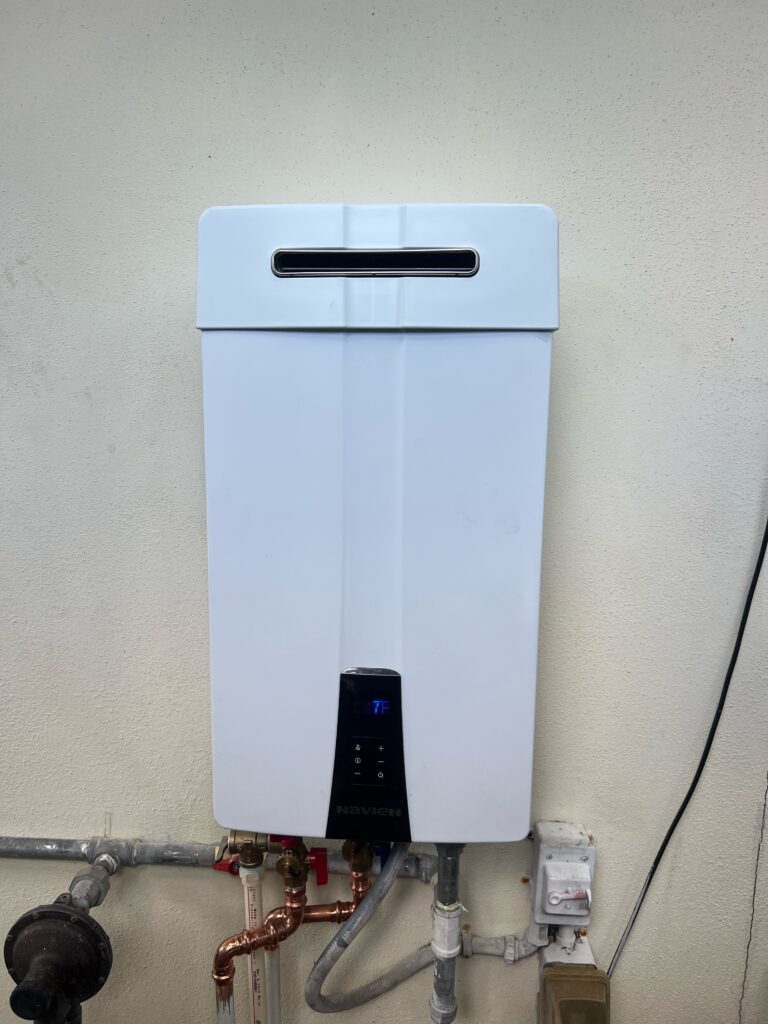
Which Tankless Hot Water Heater Makes Sense in Florida?
Florida’s generally warmer incoming water can reduce the temperature rise needed compared with colder regions. That can help either design deliver more flow for a given heating capacity. It does not eliminate the efficiency advantage of a condensing water heater.
Consider the specific location: an outdoor replacement with a compatible existing setup presents a different project from an indoor installation needing new vents and a condensate route. Outdoor equipment must be approved and configured for that use. Coastal exposure and service access also deserve attention.
For a Florida hot water heater replacement, compare two complete proposals where practical. The best choice balances installation constraints, fuel use, maintenance access and household demand.
Does Condensing Mean More or Faster Hot Water?
Not by itself. Size a tankless water heater by the hot-water flow needed at the same time and the required temperature rise. As the Building America Solution Center explains, the selected model must deliver the required gallons per minute at that rise, with adequate gas supply.
For example, heating incoming water from 75°F to 120°F requires a 45°F rise; starting at 50°F requires a 70°F rise. Those are illustrative temperatures, not a prediction for your home. Compare the manufacturer’s performance curve, not just the largest GPM number on the box. Our sizing guide explains how to plan around simultaneous demand.
Either tankless hot water heater can also leave you waiting while cooled water clears from a long pipe. Condensing technology does not solve that distribution delay. A properly designed recirculation system may help; see our guide to waiting for hot water at the faucet.
Water Heater Maintenance: Both Types Need Attention
A non-condensing hot water heater is not maintenance-free. Both designs need the inspections, filter cleaning and descaling specified for the model and your water conditions. Rinnai’s maintenance guidance emphasizes water quality when determining service frequency.
A condensing water heater adds condensate components to the service checklist, including any neutralizer or pump. Ask the installer what maintenance is required, how the equipment can be accessed and what the warranty requires. Lower complexity alone is not a reliable prediction of service life.
Which Tankless Water Heater Should You Choose?
- Consider condensing when efficient fuel use is a priority, a suitable condensate route is available and the complete installation cost makes sense for your expected usage.
- Consider non-condensing when the lower equipment cost remains attractive after venting is included, or a compatible replacement avoids substantial installation changes.
- Compare the exact models for flow at your required temperature rise, recirculation features, warranty coverage and local service support.
If you are still choosing among gas, electric and heat-pump equipment, our types of hot water heaters guide and water heater selector can help narrow the options.
Frequently Asked Questions
Can I replace a non-condensing tankless water heater with a condensing model?
Often, yes. The project needs a review of vent compatibility, condensate disposal, gas capacity, electrical supply and mounting requirements. It should not be assumed to be a direct swap.
Is a condensing hot water heater always worth the extra cost?
No. Its higher efficiency must be weighed against the complete installation price, your hot-water usage, fuel costs and expected ownership period. Ask for a comparison using your home rather than a universal payback claim.
Does a non-condensing tankless hot water heater need a drain?
It does not produce condensate through a secondary heat-recovery stage, but some vent arrangements require collection and drainage. The selected model’s installation manual determines the requirement.
Plan Your Tankless Installation with Water Heating Experts
Water Heating Experts helps homeowners in Palm Beach Gardens, Jupiter, Tequesta, Juno Beach, West Palm Beach and Wellington evaluate replacement options.
Explore our tankless water heater installation service, or text photos of your current hot water heater and its location to 561-602-9062. Prefer to talk? Call 561-602-9062.
Questions and comments
Have a question about this article? Share it below. Comments are reviewed before publication. For service, text WHE at 561-602-9062.