
Essency Water Heater: How the EXR Works
The Essency EXR water heater has a 55-gallon tank, but the water in that tank never comes out of your showerhead. Instead, the tank holds heat in reserve. When you open a faucet, a heat exchanger uses that reserve to warm fresh water on its way to the tap. That distinction explains both the appeal of this electric hot water heater and its limits.
Water Heating Experts has not installed an Essency water heater. This guide uses Essency’s published specifications, installation manual and residential warranty. The photos are Essency’s own product images. The company introduced the EXR in 2022 and announced an updated EXR and the EXR-D in 2025.
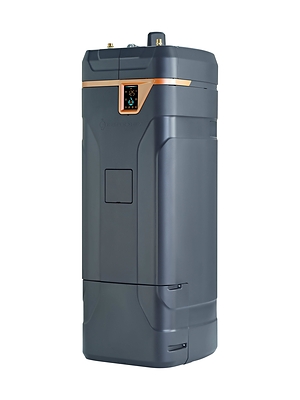
How does an Essency water heater work?
Picture two separate paths. In the first, electric elements heat water inside an unpressurized, double-wall polymer tank. When someone opens a hot tap, an internal pump sends that stored water through one side of a heat exchanger. In the second path, incoming household water flows through the other side, picks up heat and continues to the fixture. The two streams stay separate.
A conventional electric tank refills with cold water as you draw hot water out. In the Essency EXR, most of the same water stays in the tank. The polymer reservoir itself cannot rust like a steel tank. The household-water side still has components exposed to your water supply; Essency’s installation and operation manual says the heat exchanger may need flushing depending on water quality.
55, 80 or 100 gallons: what do the numbers mean?
55 gallons is the tank capacity. 80 gallons is the published first-hour rating. The latter describes hot water delivered during a test that starts with the heater fully heated. It does not mean the tank holds 80 gallons or that the unit can deliver another 80 every hour. Essency’s EXR specification sheet lists recovery at 21 gallons per hour at a 90°F temperature rise.
The 100-gallon figure in the homeowner brochure is a separate manufacturer result for Heat+ mode, tested under conditions similar to the standard first-hour test. It is neither a larger tank nor the standard first-hour rating.
For example, if a large tub uses most of the stored heat just before two morning showers, the question is how quickly the heater can recover. If the same baths and showers are hours apart, that household has a different sizing problem. Compare first-hour ratings for the tanks you are considering and use WHE’s water heater sizing guide to estimate your busiest hour.
How does it compare with tankless and heat pump models?
Compared with a tankless hot water heater: Both heat incoming water as it flows, but the EXR draws on a finite reserve of stored heat. A tankless model is sized for the flow it can sustain at a given temperature rise. If your main goal is several long, overlapping showers, ask for that comparison at your home’s incoming water temperature.
Compared with a heat pump water heater: The EXR uses electric resistance elements. A hybrid uses a heat pump to draw heat from the surrounding air. Essency lists a Uniform Energy Factor (UEF) of 0.93 for the EXR. If reducing the electric bill is your priority, compare operating-cost estimates and installed prices for similarly sized options. Our guide to water heater types explains the differences.
EXR controls and the EXR-D option
Essency’s touchscreen and MyEssency app let homeowners manage settings such as a temporary Boost for guests or Vacation mode while the home is unoccupied. For a seasonal home in Florida, ask the installer to demonstrate how to restore normal operation before your return and who can respond locally if you receive a leak alert.
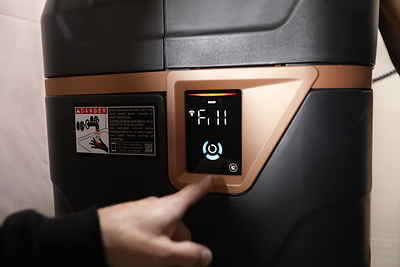
The EXR-D adds a connection for participating utility demand-response programs. It is worth asking your utility whether it supports the model, supplies the communications module and offers a benefit for enrolling. The letter D does not mean a bigger tank.
What does Essency’s 20-year warranty cover?
The Essency residential EXR warranty lists 10 years on the tank, extended to 20 years if the homeowner registers within 30 days of installation. It lists six years on covered parts, subject to conditions, and a flat-rate contribution toward labor for preauthorized covered failures during the first year. That 20-year figure does not extend to every component or service visit.
Keep the installation invoice: the policy uses the manufacture date if proof of installation is unavailable. Before buying, ask who handles local diagnostics and warranty claims for your model. Essency’s projected service life is a manufacturer estimate; WHE has no field history with these units from which to judge longevity.
What to check before replacing your current heater
The EXR is an indoor unit. Its listed cabinet dimensions are 65 inches high, 22 inches wide and 26 inches deep. Measure the path through the door as well as the final location. A cabinet that fits inside a closet can still leave too little room to reach the controls, service panels or connections.
Ask for an installed quote that identifies the model, electrical requirements, overflow drain route, service clearances and any piping changes. The EXR spec sheet lists 240-volt power and 4,500-watt elements; have the installer check the actual circuit and model instructions before assuming the existing electrical supply will work. If you use a recirculation pump or have hard well water, bring that up before the quote.
Essency hot water heater questions
Can an Essency EXR run out of hot water?
Yes. Once demand draws down the stored heat faster than the elements replace it, output is limited by recovery. For a large household, compare the busiest hour and back-to-back use rather than relying on a promised number of showers.
Will it get hot water to a distant bathroom faster?
Heating at the unit and delivery to the tap are separate issues. Water already sitting in a long pipe still has to move before hot water reaches the bathroom. Ask about the pipe layout and compatible recirculation options if waiting at a faucet is the problem.
Where can I find an Essency installer?
Use Essency’s contractor locator to check installation and service coverage for your ZIP code. For Palm Beach County homeowners weighing a conventional tank, hybrid or tankless alternative, WHE’s water heater selector can help narrow the choices.
Questions and comments
Have a question about this article? Share it below. Comments are reviewed before publication. For service, text WHE at 561-602-9062.