
Water Heater Expansion Tank: Do You Need One?
A water heater expansion tank absorbs the extra volume created when water heats up. In a closed plumbing system, that expanding water needs somewhere to go. A properly selected and installed tank helps control the resulting pressure increase.
If you are searching for an expansion tank for a hot water heater, you probably want to know whether your home needs one, what size to buy or why the existing tank is leaking. The answer starts with your plumbing layout and measured water pressure—not just the gallon capacity printed on the heater.
What does a water heater expansion tank do?
Inside a typical potable-water expansion tank, a flexible diaphragm separates water from a cushion of compressed air. As heated water expands, it enters the tank and compresses that air. The stored water can return to the plumbing as pressure falls. Watts describes this design as a way to accommodate thermal expansion in a drinking-water system.
The small tank near your hot water heater is therefore a pressure-control component. It does not heat water, increase the heater’s recovery rate or serve as another tank of usable hot water.
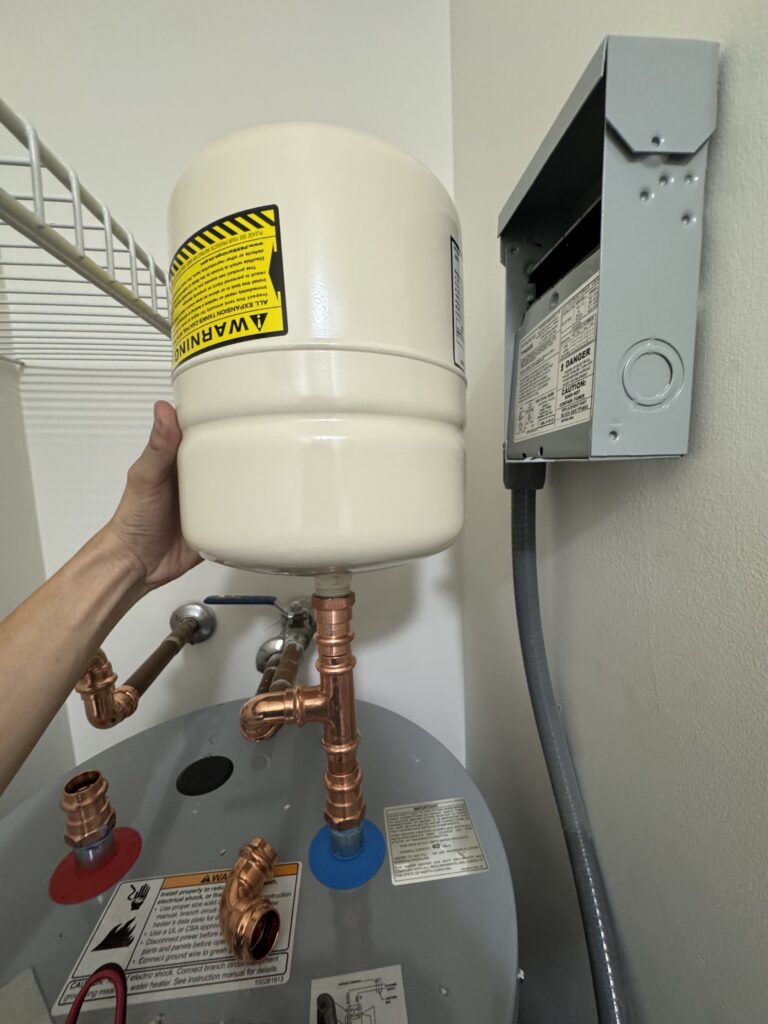
When do you need an expansion tank for a hot water heater?
Thermal expansion control is especially important when a storage heater is supplied through a check valve, backflow preventer or pressure-reducing valve that prevents reverse flow. These components can create a closed system, trapping the extra volume produced during heating. Watts’ thermal expansion guide explains how this can cause excessive pressure and relief-valve discharge.
A hot water heater may operate for years without an obvious symptom and still need its expansion control evaluated. A new meter, backflow device or pressure regulator can also change how the system behaves. The absence of an old expansion tank does not establish that the replacement installation should omit one.
Requirements depend on the applicable plumbing code, the heater manufacturer and the actual installation. WHE checks the arrangement rather than assuming every home has the same water supply. This applies to electric, gas and hybrid storage models.
Florida and Palm Beach County expansion tank considerations
Palm Beach County’s Building Code Advisory Board addressed this issue in a 2008 technical advisory. It explained the pressure problems caused by closed systems and recommended expansion tanks over auxiliary thermal-expansion relief valves for single-family homes in areas with high street pressure. That advisory is useful local background; the current code and project requirements still govern the installation.
Do not confuse those auxiliary valves with the hot water heater’s temperature-and-pressure relief valve. During a water heater replacement, ask how thermal expansion, incoming pressure and required safety devices will be addressed. For a condo, shared piping and association requirements also need review.
What size expansion tank does your water heater need?
A universal “2-gallon tank for every 50-gallon heater” rule is not reliable. The Watts potable expansion tank sizing calculator uses several inputs, including heater volume, initial pressure, precharge, temperature change and allowable final pressure.
- Stored water volume: The amount of water being heated affects the expansion volume.
- Cold-water pressure: Higher supply pressure leaves less room for pressure to rise.
- Temperature change: Sizing considers the starting water temperature and the maximum operating temperature.
- Tank acceptance: The usable expansion capacity differs from the tank’s total physical volume.
That is why a 40-, 50- or 80-gallon hot water heater should be matched to the chosen manufacturer’s sizing method. A tank that fits the available space is not necessarily large enough for the application.
Choosing the main heater’s capacity is a separate decision. Our water heater sizing guide explains household hot-water demand, while expansion tank sizing addresses the pressure produced during heating.
Where should a thermal expansion tank be installed?
For the potable models covered by Amtrol’s guidance, the tank connects to the cold-water inlet piping on the heater side of the check valve or backflow preventer. Placement must let it accept the expansion from the heater. Installing it on the wrong side of a one-way device defeats that purpose.
Orientation, support and access depend on the selected model. Do not assume a tank can simply hang from any convenient fitting. Its mounting must account for its full weight if filled with water, with drainage provisions and room for inspection.
The air precharge also matters. It generally needs to match the measured cold-water supply pressure at the installation, following the tank instructions. A factory setting is not automatically correct for your home. Watts’ PLT instructions require adjustments with zero water-side system pressure. Have a qualified installer handle pressure checks and setup.
Expansion tank, pressure regulator and shutoff: different jobs
| Component | Main purpose |
|---|---|
| Thermal expansion tank | Accepts the extra water volume created by heating. |
| Pressure-reducing valve | Reduces excessive incoming supply pressure. |
| Temperature-and-pressure relief valve | Provides emergency relief for unsafe temperature or pressure. |
| Automatic water shutoff | Closes a water valve in response to its controls or a detected problem. |
An expansion tank is not a cure for persistently excessive street pressure. The hot water heater’s relief valve is not a substitute for properly designed expansion control, either. Never cap, plug or block a relief valve or its discharge pipe.
Similarly, Moen Flo whole-house leak protection and thermal expansion control address different problems. A smart shutoff does not replace a required expansion tank, and an expansion tank does not automatically shut off a leak.
Signs your hot water heater expansion tank needs attention
Arrange an inspection if the tank is leaking, visibly corroded, damaged or pulling on its piping. Repeated relief-valve discharge or pressure that climbs during reheating can also point to an expansion-control problem, but those symptoms do not prove the tank alone is at fault.
WHE can assess the expansion tank, incoming pressure, connections and relief valve together. Replacing a dripping relief valve without finding the cause may leave the underlying problem unresolved. See our water heater repair and maintenance services for help with leaks and pressure concerns.
Follow the maintenance schedule for your model. Amtrol’s residential tank instructions call for a professional system check yearly, and more often as it ages. They also direct replacement of a corroded or damaged tank rather than attempting to recharge it.
Expansion tank replacement cost and service life
Installed cost depends on the required tank size, access, mounting, piping changes and whether a pressure-regulator or other repair is needed. Replacing a suitable existing tank is a different project from adding one where no connection or support exists.
Send WHE a wide photo of the water heater and piping, a close-up of the expansion tank label, and your city for an estimate. Include any visible leak or pressure symptom. We can discuss expansion tank work on its own or alongside a planned replacement installation.
There is no single replacement birthday that fits every tank. Water conditions, operating pressure, setup and tank condition all matter. A warranty period is not a promise of service life. Keep the installation date and model information, and have the tank checked when the hot water heater is serviced.
Frequently asked questions
Will an expansion tank give me more hot water?
No. It accommodates thermal expansion rather than adding usable hot-water capacity. If showers are running cold, review heater sizing, recovery and possible faults. Our sizing guide also discusses booster options where appropriate.
Does a tankless hot water heater need an expansion tank?
Check the specific manufacturer’s instructions and the complete system design. Tankless installations can include small storage volumes, recirculation and check valves. Do not assume that the word “tankless” automatically eliminates the need for expansion control.
Should I reuse the expansion tank when replacing my water heater?
Have its condition, age, size, precharge and mounting assessed first. A change in heater capacity or operating conditions can change the sizing requirement. Reuse should be a checked decision, not an automatic carryover.
Expansion tank installation in Palm Beach County
Water Heating Experts installs and replaces expansion tanks as part of our hot water heater services. We serve Palm Beach Gardens, Jupiter, Tequesta, Juno Beach, West Palm Beach, Wellington, Royal Palm Beach and Loxahatchee, including Loxahatchee Groves.
Text 561-602-9062 with photos and a description of the issue, or send your project details. If you are also choosing a new heater, our water heater selector can help you compare options.
Questions and comments
Have a question about this article? Share it below. Comments are reviewed before publication. For service, text WHE at 561-602-9062.