
A.O. Smith Hybrid Heat Pump Water Heater Installation in Florida
Hybrid water heater installation in Florida can be a practical upgrade for homeowners replacing a conventional electric storage-tank water heater, particularly when there is suitable space in a garage. This Water Heating Experts project shows an A.O. Smith hybrid heat-pump water heater installed in a customer’s garage in place of an older electric tank. Below are the original WHE before-and-after photos, what a hybrid does differently, and the installation details we evaluate today.

What changed in this A.O. Smith garage installation?
The original WHE project replaced an older conventional electric tank with an A.O. Smith hybrid electric water heater. The heater remained a storage-tank system, but its heat pump could move warmth from the garage air into the stored water. That technology uses a fan and refrigeration components rather than relying solely on electric-resistance heating. The exact historical model number and efficiency rating are not established by this archived photograph, so we do not apply a current model’s published specifications to it.
One practical side effect is that a heat-pump water heater can blow cooler air into the room while it runs. In a warm South Florida garage, that may feel welcome, but the cooling and energy savings depend on operating conditions and are not a substitute for room air conditioning.
How does a hybrid heat-pump water heater work?
In heat-pump mode, the unit collects heat from the surrounding air and transfers it into water inside the tank. Many hybrid electric models also have electric-resistance heating elements to help meet demand or operate when ambient conditions are outside the heat pump’s preferred range. Operating modes, element sizes, noise levels and recovery rates vary by model.
Because the heat pump moves heat instead of making all the heat through electrical resistance, a qualifying unit can use substantially less electricity than a comparable standard electric-resistance storage heater. But a generic annual savings claim—such as a guaranteed $400 per year—would be misleading. Savings depend on the existing equipment, hot-water use, electricity price, installation conditions and selected operating mode. ENERGY STAR provides buying and efficiency guidance for comparing equipment.
Is a Florida garage a good place for a hybrid water heater?
Often it is worth evaluating. Garages in Palm Beach County frequently provide warm air that a heat-pump water heater can use, and they may offer better service access than a cramped attic. However, not every garage is a suitable installation location. The manufacturer’s instructions govern permitted air temperatures, clearance around the air intake and discharge, minimum available room volume or approved ducting, space for maintenance and protection from damaging water leaks.
Some modern integrated models require around 450–700 cubic feet of available surrounding air space unless approved ventilation or ducting is provided. Those figures are examples, not a universal clearance rule: always confirm requirements for the exact model and installation configuration. ENERGY STAR’s design guidance discusses the differences.
What WHE checks before installing a hybrid water heater
- Hot-water capacity and recovery: the household’s busiest hour, simultaneous showers, bathtubs and the model’s first-hour rating—not tank gallons alone.
- Room dimensions and airflow: minimum air volume or model-approved venting, compressor and fan clearances, and whether an air filter can be cleaned without moving the tank.
- Condensate drainage: a suitable gravity drain or condensate pump, with routing appropriate to the location.
- Electrical supply: the exact unit’s voltage, breaker, wiring and any model-specific electrical work, assessed by qualified personnel.
- Plumbing and safety: compatible water connections, shutoff valve, temperature-and-pressure relief discharge, water pressure, thermal expansion requirements and leak protection.
- Access and noise: tank dimensions, weight when full, service accessibility, fan/compressor noise and whether the cooler discharge air will affect nearby occupied areas.
WHE commonly uses rigid copper piping and press fittings where appropriate, but connection materials must suit the specific heater and the manufacturer’s instructions. Flexible connections can be a legitimate option for certain heat-pump installations and should not be dismissed categorically. This is professional planning guidance rather than a do-it-yourself electrical or plumbing procedure.
A separate, more recent WHE hybrid water heater installation
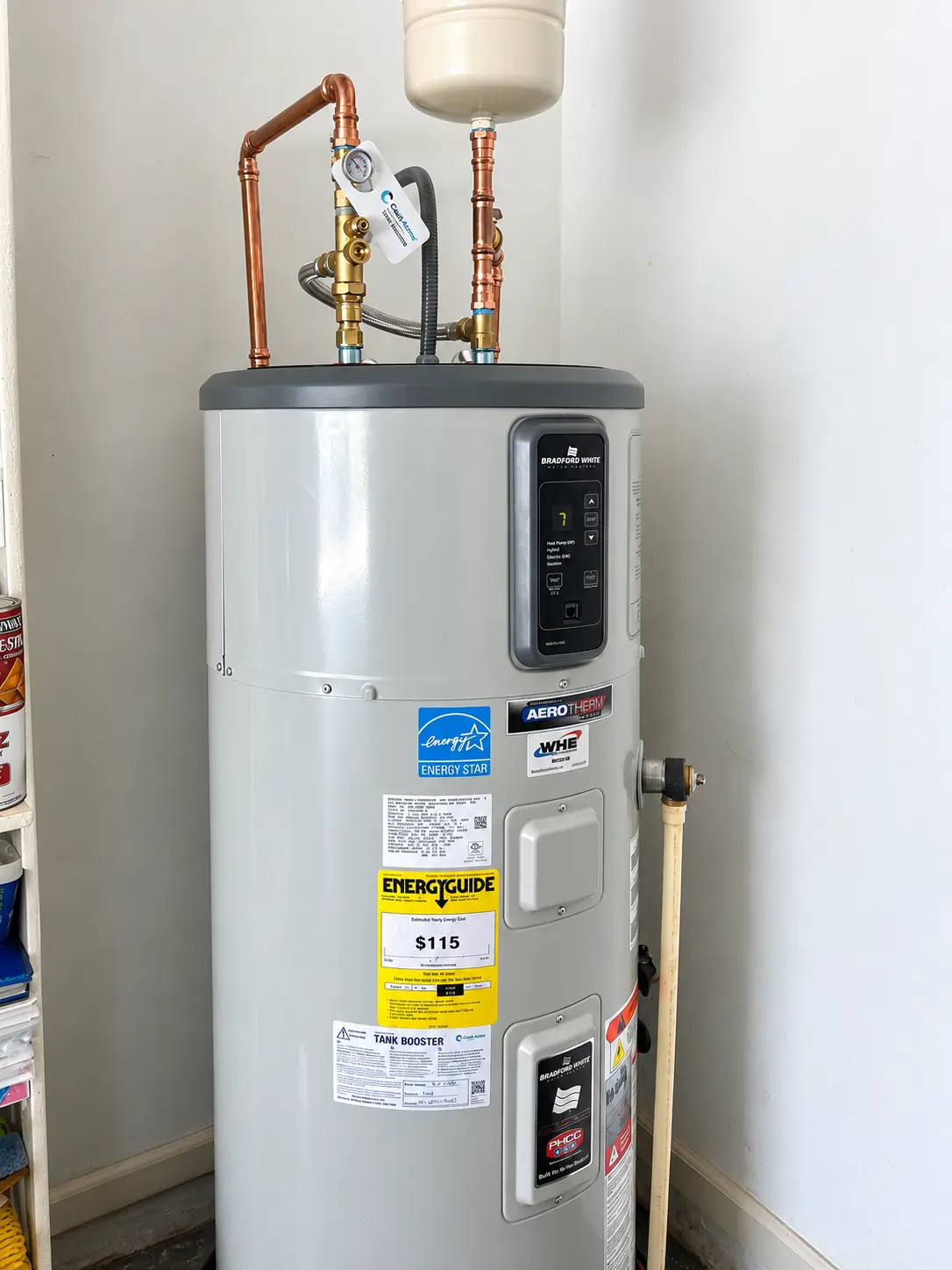
This WHE photograph shows a Bradford White AeroTherm heat-pump water heater installed with a mixing-valve tank booster and an expansion tank. It is a different job and brand from the original A.O. Smith garage project. We include it to show a real, more recent heat-pump installation and the kinds of components that may be appropriate when a job calls for them—not to imply every hybrid requires the identical piping arrangement.
Choosing the right size and comparing alternatives
Residential hybrid heat-pump water heaters are commonly offered in roughly 50-, 65/66- and 80-gallon size classes, depending on manufacturer and product family. Actual stored gallons and first-hour delivery vary. A larger tank might make sense for high peak demand, but available height, garage layout and electrical requirements can limit the options.
For large-capacity choices, compare our 80-gallon replacement options. For heat-pump versus tankless tradeoffs, read Hybrid Heat Pump vs. Tankless Water Heaters. Individual A.O. Smith hybrid models have their own current specifications; this page is a field installation case study, not a product listing.
What about rebates and tax credits in 2026?
Do not assume a federal heat-pump water heater tax credit applies to a new 2026 installation. The IRS states that the federal Energy Efficient Home Improvement Credit under section 25C is unavailable for property placed in service after December 31, 2025. Separate utility or local incentives, if any, require current verification and may have different conditions. See the IRS termination-date explanation; check relevant utility programs before planning costs around a rebate.
Frequently asked questions
Are hybrid heat-pump water heaters a good fit for Florida garages?
They often can be, because warm garage air may support heat-pump operation. We still check the exact manufacturer’s airflow, ambient-temperature, drain and service-clearance requirements before recommending the location.
Does a hybrid water heater really save $400 every year?
Not necessarily. A heat-pump water heater can use less electricity than a conventional electric-resistance tank, but annual dollar savings depend on the equipment being replaced, usage, rates and operating mode. A fixed annual savings guarantee would be inappropriate.
Does a heat-pump water heater cool the garage?
It can discharge cooler air while the heat pump runs. The effect varies with the size and ventilation of the garage, ambient conditions and unit operation. It is not a substitute for home air conditioning.
Can I replace a standard electric water heater with a hybrid?
Often, but we must check the space, electrical circuit, room airflow, condensate drainage, dimensions and water-heater sizing. A matching gallon label alone does not guarantee an easy replacement.
Does a hybrid water heater need a condensate drain?
Integrated heat-pump water heaters produce condensate during operation. The installation must have approved drainage or a suitable pump and a maintenance plan for the condensate path.
Will a hybrid heater run out of hot water?
It can. Hybrids are storage-tank systems with finite usable water volume and model-specific recovery capabilities. Correct sizing and operating mode matter during back-to-back showers or simultaneous fixture use.
Should I choose an A.O. Smith, Rheem or Bradford White hybrid?
Start with the correct capacity, recovery, efficiency, ambient requirements, electrical configuration, model availability and service access. WHE can evaluate the specific models and installation; this article does not rank a universal best brand.
Does the federal heat-pump water heater credit apply in 2026?
The IRS states that the federal Energy Efficient Home Improvement Credit ended for property placed in service after December 31, 2025. Ask the relevant utility about any separate current incentive and verify eligibility before purchasing.
Request a hybrid water heater installation estimate
Water Heating Experts LLC is family-owned and master-plumber-owned, Florida Certified Plumbing Contractor CFC1426133. We evaluate hybrid water heater replacements in Palm Beach Gardens, Jupiter, Tequesta and surrounding northern Palm Beach County communities. Send a photo of your current water heater’s model label and a wider photo showing its location; mention whether it is in a garage, attic or closet.
Call WHE at 561-602-9062 or request an installation estimate. We’ll evaluate the equipment and actual installation requirements before recommending a model.
Original WHE garage installation case study preserved; guidance refreshed October 15, 2026. Photographs show separate jobs as labeled. Follow the actual water heater’s current manufacturer instructions and applicable local requirements.
Questions and comments
Have a question about this article? Share it below. Comments are reviewed before publication. For service, text WHE at 561-602-9062.